
Introduction
Law enforcement professionals’ mental and physical health is negatively impacted by police officer stress, which is a serious problem. The impacts of police tension might range from mild to severe. Stress typically causes social disengagement, headaches, fatigue, and agitation or fury, among other symptoms. Over time, stress can lead to more severe physical health problems, including high blood pressure and heart disease. Developing gender-specific stress manifestations is essential to creating systems of support that work.
In addition, compared to males, women are more inclined to seek out social support and avoid. Men, on the other hand, solved problems and separated themselves from the issue. Research methodologies include using databases such as FLITE and exploring concepts such as gender disparities and the stress experienced by correctional officers. The study aims to determine whether stress levels differ significantly between male and female police officers.
Analysis of Work Environment Variables
Police officers’ stress levels are influenced by a variety of work environment factors, including working shifts, being around violent people, and facing administrative demands. Two broad categories can be used to categorize sources of stress in law enforcement. The first category pertains to stressors originating from job content, including work schedules, shift work, long work hours, overtime, court work, traumatic events, and threats to one’s physical or mental well-being (Queirós et al., 2020). The second category consists of stressors originating in the job context, including organizational traits and individual conduct that generate stress.
The most significant percentage of variation in reported stress is caused by interpersonal work environment stressors such as lack of confidentiality, sexual harassment, gender discrimination, and interpersonal conflict; organizational and operational stress also affects general stress levels among female officers. Due to prejudice and cultural considerations, members of racial and ethnic minorities may experience additional pressures. They also consider themselves in a “lower position” within society. Depression, worry, and a sense of being “the other” might result from this.
Research indicates that stress may be reduced via training, task management, and organizational support (Grupe et al., 2021). Businesses must proactively alleviate workplace stress to mitigate such organizational implications. Employees can manage stress by implementing stress-reduction programs, fostering a supportive work environment, and providing tools.
Gender Differences in Police Officer Stress
Compared to male cops, female officers exhibit much higher mean stress ratings in several categories, especially safety considerations. Studies reveal that female law enforcement personnel frequently experience higher stress levels than their male colleagues (Purba & Demou, 2019). There may be a higher burden placed on women because they are more likely to believe there is a double standard considering their gender in law enforcement. Therefore, women must consistently outperform their male peers to be considered competent. Women cops might be much more vulnerable to stress, including an increased rate of anxiety, worry, exhaustion, and depression, than their male colleagues.
Furthermore, an elevated stress level may account for other health problems such as high blood pressure and heart disease. The female officers have the additional burden of balancing their families and their jobs, and as a result, these duties will increase stress in their family life. Promoting equal opportunities for women in law enforcement requires addressing gender differences in resource allocation and support networks.
Case Study: Meditation Training for Police Officers
According to a case study by Vadvilavičius et al. (2023), a police department trained its personnel in mindfulness meditation to lower stress and build resilience. The program included instruction in stress management and coping mechanisms, as well as weekly meditation sessions led by qualified teachers. Officers of all genders, representing a variety of positions and lengths of service, participated.
Participants completed surveys measuring their reported stress levels, mood, and work satisfaction before and after the intervention. According to the results, all participants’ subjective stress levels significantly decreased following the meditation instruction. Officers of all genders reported feeling more at ease, more concentrated, and more capable of managing the rigors of their jobs. Participants also mentioned feeling happier and experiencing less anxiety and irritation.
The meditation practice did have some favorable effects, but a six-month follow-up study showed a clear gender difference in retention rates. Compared to their male colleagues, female police officers had a significantly higher departure rate from the department (Vadvilavičius et al., 2023). Exit interviews and questionnaires were analyzed, and the results showed that female officers’ main reasons for quitting were greater stress levels and inadequate support networks. Moreover, female police officers expressed dissatisfaction with the department’s lack of efforts expressly designed to address their distinct pressures and obstacles. Even while meditation training had advantages, it was insufficient to address the structural problems that led to female officers’ increased stress levels and discontent with their jobs.
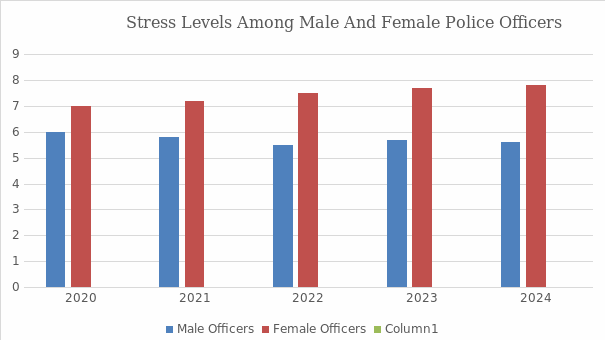
The stress levels of male and female police officers are shown in Figure 1 for five years. The statistics show that many cops report high levels of stress. It shows a pattern where female officers often report feeling more stressed than their male counterparts, suggesting that there may be a gender difference in the stress levels that law enforcement personnel face.
Conclusion
In conclusion, female police officers report higher rates of job resignation than their male colleagues, indicating that they suffer more significant adverse effects from stress. Research on gender disparities and police officer stress is probably going to concentrate on specialized treatments and preventative measures during the next five years. Law enforcement agencies may see a policy shift that prioritizes diversity training and mental health care. Putting stress-reduction techniques that work into practice is essential to improving police resilience and maintaining public safety.
References
Grupe, D. W., Stoller, J. L., Alonso, C., McGehee, C., Smith, C., Mumford, J. A., Rosenkranz, M. A., & Davidson, R. J. (2021). The impact of mindfulness training on police officer stress, mental health, and salivary cortisol levels. Frontiers in Psychology, 12.
Purba, A. K., & Demou, E. (2019). The relationship between organisational stressors and mental wellbeing within police officers: a systematic review. BMC Public Health (Online), 19(1).
Queirós, C., Passos, F. C., Bártolo, A., Faria, S., Fonseca, S. M., Marques, A., Da Silva, C. F., & Pereira, A. (2020). Job stress, burnout and coping in police officers: Relationships and psychometric properties of the organizational police stress questionnaire. International Journal of Environmental Research and Public Health (Online), 17(18).
Vadvilavičius, T., Varnagirytė, E., Jarašiūnaitė‐Fedosejeva, G., & Gustainienė, L. (2023b). The effectiveness of mindfulness-based interventions for police officers’ stress reduction: A systematic review. Journal of Police and Criminal Psychology.