
Executive Summary
The current policy brief addresses the federal-level issue of gun violence in the United States and its management with the use of background checks. Drawing on the concepts and structural elements of policy writing, the report explains the rationale for addressing firearm-related brutality, proposes a solution, and offers considerations for addressing the situation (International Center for Policy Advocacy, 1). The most recent regulation regarding background checks, the Bipartisan Safer Communities Act, has policy flaws in its language and logic.
The brief assesses the Act’s drawbacks and recommends designing a new policy that imposes more stringent requirements for assessing one’s eligibility to obtain and carry guns. The report argues that such an approach is evidence-based and can be helpful, but there is no federal policy yet that offers adequate guidance on the matter. There is a need to create and implement a new policy that will impose background checks to reduce gun violence, but doing so requires a joint effort from politicians, Congress, and the Department of Justice.
Gun Violence in the United States
Among the present issues prevalent in the United States (US), gun violence (GV) is one of the most pressing. The matter of GV does not simply apply to a local context but is instead a federal challenge (International Center for Policy Advocacy, 1). The issue is vital because the incidents of GV are heightened across the nation and are increasing (Population Reference Bureau, 2).
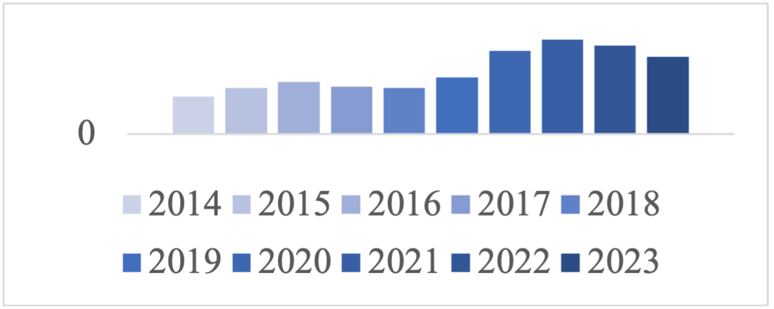
The US has the highest rate of deaths related to GV among developed countries (Raissian, 3). For example, the occurrence of mass shootings (MSs) can represent the severity of GV, with the US having witnessed over 600 MSs in the last three years, which is about two every day. Graph 1 demonstrates the growth in the number of MSs across the US over the past decade, with the current year already reaching an elevated level (BBC, 4). Consequently, there is a need to advocate for a change in how GV is managed (International Center for Policy Advocacy, 5). A new policy should be implemented to control GV, with politicians promoting tougher background check (BC) requirements due to a high number of US citizens having firearms.
A Flawed Policy
The US government has recently implemented a way to regulate who can have guns. In 2022, Congress passed the Bipartisan Safer Communities Act (BSCA) to oversee BCs, yet BSCA cannot achieve much due to policy-related core issues (International Center for Policy Advocacy, 1; Leider, 6; Population Reference Bureau, 2). Raissian suggests that the latest major federal policy has internal inconsistencies since its strategies do not correspond with the existing legislature (3).
Leider states that BSCA has both significant and modest provisions, alongside serious technical deficiencies, that would prevent it from reducing GV (6). Such drawbacks are due to Senators attempting a different approach to BSCA that concentrated on involving a small party of decision-makers who met in private, decided on the language, and harshly passed BSCA. Moreover, no ordinary hearings were held, and amendments were rejected to promptly provide a GV solution expected by the public after two MSs (Leider, 6). Therefore, the new GV policy must address BSCA’s defects, which can be accomplished by politicians working with interest groups to formulate better language and an agenda for BCs.
Although Congress passed BSCA quite recently, the Act is unlikely to address GV in the US. There is one significant impact arising from failures in BSCA’s design that should be noted (International Center for Policy Advocacy, 1). Although BSCA has changed the requirements for receiving guns, it has adjusted the conditions for possession. As a result, firearms are likely to be legally owned by individuals who are not allowed to acquire them and supplied to people who are not permitted to have guns (Leider, 6).
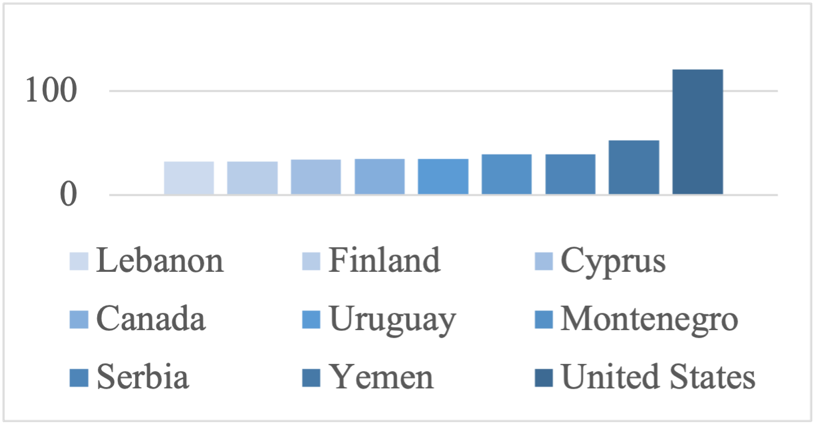
Consequently, BSCA’s deficiencies may not be sufficient to provide BCs that would reduce the number of citizens who have weapons, which is already strikingly high. For instance, Graph 2 demonstrates gun-owning rates in different countries, and the US ranks remarkably higher than others (BBC, 4). The nation has over 120 firearms per 100 residents, and about 44% of adults live in gun-possessing households (BBC, 4; Raissian, 3). Accordingly, the US allows numerous individuals to own firearms, and the current policy has drawbacks that may prevent thorough BCs.
The Solution
Among the options for managing GV, a policy focused on tougher BCs should receive more attention. In addition to BCs, possible alternatives include permissive gun laws, purchaser licensing, and child access protection laws (International Center for Policy Advocacy, 1; Raissian, 3; Strayer University, 9; Valek, 8; Zeoli, 7). Nonetheless, the proposed solution is enhanced BCs, as the selected evaluation criteria assess whether an option is supported by research findings (International Center for Policy Advocacy, 1).
For example, Zeoli states that BCs are essential for evidence-based policy related to GV (7). Similarly, Valek lists BCs among evidence-based gun laws that can be highly effective (8). Consequently, the new policy should focus on advanced BCs, as prior investigations have demonstrated the approach’s usefulness.
Furthermore, there are additional reasons for developing a policy for tougher BCs. The argument is that the above-mentioned options may not be as helpful in managing GV in the US (International Center for Policy Advocacy, 1; Population Reference Bureau, 2). For example, Raissian notes that permissive gun laws may negatively impact public safety (3). Zeoli suggests that purchaser licensing regulations are uncommon, protective, and likely to mandate BCs (7).
Valek categorizes child access protection statutes as evidence-based laws. Still, they are applicable for managing GV regarding minors, whereas there is a need to reduce GV across the US, including adults (8). Accordingly, the new policy should focus on BCs over other alternatives since the selected approach is one based on research and relevant to the nation’s majority.
The Role of Congress
The question of what to do to make the solution effective depends on input from different parties. While a definitive answer on the approach’s design has yet to be determined, it is necessary to mobilize support within and outside Congress to enhance performance (International Center for Policy Advocacy, 5; Strayer University, 9). One can argue that Congress has recognized the importance of BCs by addressing them in the latest GV rule, BSCA. However, while Congress is influential in enacting policy, it is not the sole decision-maker because it depends on voters and state jurisdictions when implementing gun restrictions (Leider, 6). Therefore, the new policy requires input from within and beyond Congress.
The Most Important Stage
One can argue that implementation is the most crucial stage in policy development. The concept of implementation is essential because it ensures the selected solution is effective at both the national and local levels (Hudson, 10). At this phase, various actors must work jointly to enact the chosen approach (Hudson, 10; International Center for Policy Advocacy, 1).
For instance, the Department of Justice should enforce new rules since BC’s methods involve the criminal justice system and law enforcement (Zeoli, 7). Congress should participate in ensuring that the approach is appropriately passed to prevent BSCA’s policy-related deficiencies (Leider, 6). Politicians should promote the chosen solution to lead public opinion toward supporting the presented option (International Center for Policy Advocacy, 1). The new policy will require the support of various agencies to implement tougher BCs nationwide successfully.
A Promising Policy
If properly designed and implemented, the suggested policy can be pretty beneficial. As discussed earlier, the usage of BCs is evidence-based, meaning that such an approach is likely to be helpful (Valek, 8; Zeoli, 7). The reason BCs have not reduced GV rates in the US is that, despite high public support for expanded BCs, there has yet to be adequate federal policy action (Kantack, 11). Similarly, the latest rule addressing BC also has several policy flaws (Leider, 6). Therefore, the new policy’s effectiveness can be considered promising if it is developed and implemented correctly, with consideration of improvements over prior solutions.
Sources
- International Center for Policy Advocacy. 2017. An Essential Guide to Writing Policy Briefs.
- Population Reference Bureau. 2017. Principles of Policy Writing and Writing a Policy Brief.
- Kerri Raissian. 2022. Gun Violence and Gun Policy in the United States: Understanding American Exceptionalism.
- BBC. How Many Us Mass Shootings Have There Been in 2023?
- International Center for Policy Advocacy. No date. Empowerment. Engagement. Impact.
- Robert Leider. 2022. The Bipartisan Safer Communities Act: Doctrinal and Policy Problems.
- April Zeoli. 2022. Effectiveness of Firearm Restriction, Background Checks, and Licensing Laws in Reducing Gun Violence.
- Rebecca Valek. 2023. Age-Related Gun Regulations and Public Opinion.
- Strayer University. No Date. Policy Analysis and Program Evaluation: PAD520.
- Bob Hudson. 2019. Policy Failure and the Policy-Implementation Gap: Can Policy Support Programs Help?
- Benjamin Kantack. 2020. Does “Politicizing” Gun Violence Increase Support for Gun Control? Experimental Evidence from the Las Vegas Shooting.